Qui va sortir amb Vespasian?
Caenis data de Vespasian de ? fins a ?.
Vespasian
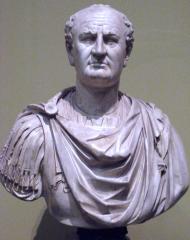
Vespasian (; Latin: Vespasianus [wɛspasiˈaːnus]; 17 November 9 AD – 23 June 79) was Roman emperor from 69 to 79. The last emperor to reign in the Year of the Four Emperors, he founded the Flavian dynasty, which ruled the empire for 27 years. His fiscal reforms and consolidation of the empire brought political stability and an extensive building program.
Vespasian was the first emperor from an equestrian family. He rose later in his lifetime into the senatorial rank—the first of his family to do so. He rose to prominence through military achievement: he served as legate of Legio II Augusta during the Roman invasion of Britain in 43, and later led the suppression of the Jewish rebellion of 66–70.
While he was engaged in the campaign in Judaea, Emperor Nero died by suicide in June 68, plunging Rome into a year of civil war known as the Year of the Four Emperors. After two, Galba and Otho, died in quick succession, Vitellius became emperor in April 69. The Roman legions of Egypt and Judaea reacted by declaring Vespasian, their commander, emperor on 1 July 69. Vespasian joined forces with Mucianus, the governor of Syria, and Primus, a general in Pannonia. They led the Flavian forces against Vitellius, while Vespasian took control of Egypt. On 20 December 69, Vitellius was defeated, and the following day Vespasian was declared emperor by the Senate.
Little information survives about the government during Vespasian's ten-year rule. He reformed the financial system of the Roman Empire after the campaign against Judaea ended successfully, and initiated several ambitious construction projects, including the building of the Flavian Amphitheatre, better known today as the Colosseum. Through his general Agricola, Vespasian increased imperial expansion in Britain. Vespasian is often credited with restoring political stability to Rome following the chaotic reigns of his predecessors. After he died in 79, he was succeeded by his eldest son Titus, thus becoming the first Roman emperor to be succeeded by his natural son and establishing the Flavian dynasty.
llegir més...Caenis

Cenis (en llatí Caenis) va ser l'amant de Vespasià. Originalment era una lliberta d'Antònia, la mare de l'emperador Claudi. Quan es va morir la dona de Vespasià, Flàvia Domicil·la, l'emperador la va agafar per viure amb ell i la va tractar com la seva muller legal.
Va exercir molta influència sobre Vespasià i va adquirir una gran riquesa degut als regals que rebia dels qui volien algun favor de l'emperador i demanaven la seva intercessió. Quan es va morir, Vespasià va posar un cert nombre de concubines al seu lloc.
llegir més...