Qui va sortir amb Hefestió de Pel·la?
Alexandre el Gran data de Hefestió de Pel·la de ? fins a ?.
Hefestió de Pel·la
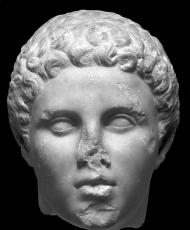
Hefestió (en llatí Hephaestion, en grec antic Ἡφαιστίων), fill d'Amintor de Pel·la, fou un macedoni de Pel·la amic i amant d'Alexandre el Gran. Sembla que de petits van créixer junts i tenien la mateixa edat, però durant anys Hefestió no apareix en la vida d'Alexandre ni en els estudis amb Aristòtil, ni durant els problemes entre Alexandre i el seu pare, Filip II de Macedònia.
Hefestió és esmentat per primer cop durant la visita d'Alexandre a la tomba d'Aquil·les a Troia, quan Hefestió va retre el mateixos honors que el rei a la tomba de Patrocle. Alexandre li va donar tots els honors que va posseir, però sembla que era conscient que no podia agafar comandaments militars delicats, ja que no hi estava prou capacitat. Alexandre, segons Plutarc i altres autors, el considerava el seu amic privat, mentre considerava Cràter l'amic del rei.
Curti diu que, el 332 aC, Alexandre li va donar el comandament de la flota a la costa de Fenícia, però en un moment en què els combats ja s'havien acabat. El 331 aC, Hefestió va combatre amb distinció a Arbela, on fou ferit, i Diodor de Sicília diu que era el cap de la guàrdia del rei (somatophilakes), (hi havia set membres de la guàrdia i era un d'aquests set). Després de la mort de Filotes (330 aC), se li va donar el comandament de la meitat de la cavalleria escollida o guàrdia de cavall, i l'altra meitat es va donar a Clit, però després de mort Clit, Hefestió va quedar com a únic comandant.
Durant les campanyes de Bactriana i Sogdiana, va rebre comandaments més compromesos i fou encarregat de fundar noves ciutats i colònies. Quan Alexandre va arribar a l'Índia, li va ordenar avançar junt amb Perdicas d'Orèstia i el rei indi Tàxiles, cap al sud a la vall de Cofen (mentre el rei s'aturava a sotmetre a les tribus del nord). A l'Indus, va conquerir una fortalesa després d'un setge de 30 dies. Després de passar el riu Acesines i derrotar el rei Porus, li fou encarregat de combatre un altre rei indi, tasca que va complir amb nota; després fou enviat a la riba oposada del riu i Cràter va dirigir l'exèrcit a l'altre costat del riu. Quan més tard les tropes es van dirigir a Gedròsia, se li va confiar el comandament del principal cos d'exèrcit, sol o junt amb Cràter.
A l'arribada a Susa, va rebre d'Alexandre corones d'or en recompensa, i li fou donada en matrimoni Dripetis, la filla de Darios III de Pèrsia i germana d'Estàtira, dona d'Alexandre. De Susa, va acompanyar Alexandre a Ecbàtana, on fou atacat per unes febres. Glauc (Glaucus, Glaukos Γλαῦκος) fou un metge grec, i fou el metge que va atendre Hefestió; tot i les seves cures, Hefestió va morir al cap de set dies. Es diu que Alexandre, que suposadament tenia una relació amorosa amb Hefestió molt intensa, va fer matar el metge per no haver pogut salvar la vida al seu company. El dol d'Alexandre fou extravagant i apassionat: es va decretar un dol general en tot l'imperi i una pira funerària monumental li fou erigida a Babilònia, on fou portat des d'Ecbàtana, i se li van retre els honors d'heroi. El rei va refusar nomenar un successor en el comandament militar de l'exèrcit i va donar el nom del difunt a la divisió de cavalleria en què havia estat quiliarca.
llegir més...Alexandre el Gran

Alexander III of Macedon (Ancient Greek: Ἀλέξανδρος, romanized: Aléxandros; 20/21 July 356 BC – 10/11 June 323 BC), most commonly known as Alexander the Great, was king of the ancient Greek kingdom of Macedon. He succeeded his father Philip II to the throne in 336 BC at the age of 20, and spent most of his reign conducting a lengthy military campaign throughout Asia and Egypt. By the age of 30, he had created one of the largest empires in history, stretching from Greece to northwestern India. He was undefeated in battle and is widely considered to be one of history's greatest and most successful military commanders.
Born in Pella, Macedon, Alexander was tutored by philosopher and polymath Aristotle until the age of 16. In 335 BC, shortly after assuming the throne of Macedon, he launched a campaign in the Balkans and reasserted control over Thrace and parts of Illyria before marching on the city of Thebes, which was subsequently destroyed. Alexander then assumed leadership of the League of Corinth, created by his father.
With this authority over all Greeks he launched a pan-Hellenic invasion of the Persian Achaemenid Empire in 334 BC, and with it began a series of campaigns which lasted for ten years. Following his conquest of Asia Minor and a series of decisive battles, particularly at Issus and Gaugamela, the power of the Achaemenid Empire was broken. He subsequently overthrew Darius III and conquered the Achaemenid Empire in its entirety. After the fall of Persia, the Macedonian Empire held a vast swath of territory between the Adriatic Sea and the Indus River. Alexander endeavored to reach the "ends of the world and the Great Outer Sea" and invaded India in 326 BC, achieving an important victory over Porus, an ancient Indian king of present-day Punjab, at the Battle of the Hydaspes. Facing mutiny from troops, he was eventually forced to turn back at the Beas River, and later died in 323 BC in Babylon, Mesopotamia, the city which he had planned to make the capital of his empire, while on his return to Greece. Alexander's death put an end to his planned invasion of Arabia.
In the years following his death, a series of civil wars broke out across the Macedonian Empire, eventually leading to its disintegration at the hands of the Diadochi. Alexander's death marks the conventional beginning of the Hellenistic period. Through his conquests, he built a legacy that includes the cultural diffusion and syncretism, which gave rise to Greco-Buddhism and Hellenistic Judaism. He founded more than twenty cities, with the most prominent being the city of Alexandria in Egypt. Alexander's establishment of Greek colonies and the spreading of Greek culture led to Hellenistic civilization becoming a major force in the ancient world, influencing regions as far east as the Indian subcontinent. The Hellenistic period developed through the Roman Empire into modern Western culture; the Greek language became the lingua franca of the region and was the predominant language of the Byzantine Empire until its collapse in 1453 AD.
Alexander became a legendary hero similar to Achilles, featuring prominently in the historical and mythical traditions of both Greek and non-Greek cultures. His military achievements and successes in battle made him the touchstone against which many later military leaders would judge themselves. His tactics remain a significant subject of study in military academies worldwide. Legends of Alexander's exploits were coalesced into the 3rd century Alexander Romance which, in the premodern period, went through over one hundred recensions, translations, and derivations and was translated into almost every European vernacular and every language of the Islamic world. After the Bible, it was the most popular form of European literature.
llegir més...