Qui va sortir amb Inan?
Harun ar-Raixid data de Inan de ? fins a ?.
Inan
Inan (en àrab عنان, ʿInān) fou una poetessa àrab de Bagdad de la meitat del segle viii. És considerada la primera dona poeta a obtenir notorietat i glòria sota els abbàssides.
Se sap ben poc de la seva vida i el que se sap és de dubtosa autenticitat. Sembla que hauria estat una muwàl·lada —una no àrab nascuda i educada entre àrabs— que hauria nascut i hauria rebut una acurada educació a la Yamama. D'allà s'hauria traslladat a la capital abbàssida juntament amb el seu amo, Abu-Khàlid an-Natifí, arribant a viure probablement també al Khurassan. Hauria mort a Egipte l'any 841. En vida hauria conegut l'esplendor literari de la cort de Harun ar-Raixid, qui s'hauria mostrat interessat pels seus dots poètics.
Es coneix ben poc de la seva obra, però els pocs versos conservats mostren una poetessa brillant. Més enllà del seu talent, però, Inan destaca perquè hauria convertit la seva casa en el centre d'una tertúlia literària a la qual haurien assistit els més innovadors dels poetes i literats àrabs del moment. Consta, en aquest sentit i a tall d'exemple, que Abu-Nuwàs, Ibn al-Àhnaf i Abu-n-Nadir li van dedicar poemes d'amor, potser no del tot sincers, però sí significatius.
llegir més...Harun ar-Raixid
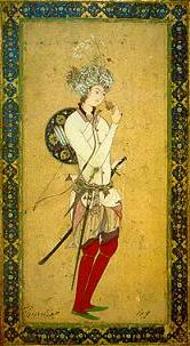
Abū Jaʿfar Hārūn ibn Muḥammad ar-Rashīd, or simply Hārūn ibn al-Mahdī (c. 763 or 766 – 24 March 809), famously known as Hārūn al-Rashīd, was the fifth Abbasid caliph of the Abbasid Caliphate, reigning from September 786 until his death in March 809. His reign is traditionally regarded to be the beginning of the Islamic Golden Age. His epithet al-Rashid translates to "the Just", "the Upright", or "the Rightly-Guided".
Harun established the legendary library Bayt al-Hikma ("House of Wisdom") in Baghdad in present-day Iraq, and during his rule Baghdad began to flourish as a world center of knowledge, culture and trade. During his rule, the family of Barmakids, which played a deciding role in establishing the Abbasid Caliphate, declined gradually. In 796, he moved his court and government to Raqqa in present-day Syria. Domestically, Harun pursued policies similar to those of his father Al-Mahdi. He released many of the Umayyads and 'Alids his brother Al-Hadi had imprisoned and declared amnesty for all political groups of the Quraysh. Large scale hostilities broke out with Byzantium, and under his rule, the Abbasid Empire reached its peak.
A Frankish mission came to offer Harun friendship in 799. Harun sent various presents with the emissaries on their return to Charlemagne's court, including a clock that Charlemagne and his retinue deemed to be a conjuration because of the sounds it emanated and the tricks it displayed every time an hour ticked. Portions of the fictional One Thousand and One Nights are set in Harun's court and some of its stories involve Harun himself. Harun's life and court have been the subject of many other tales, both factual and fictitious.
llegir més...